

2026-08-26
This leads to a fundamental engineering question: What defines a "hazardous location" for industrial lighting, and how must luminaires be specified to operate safely within them?
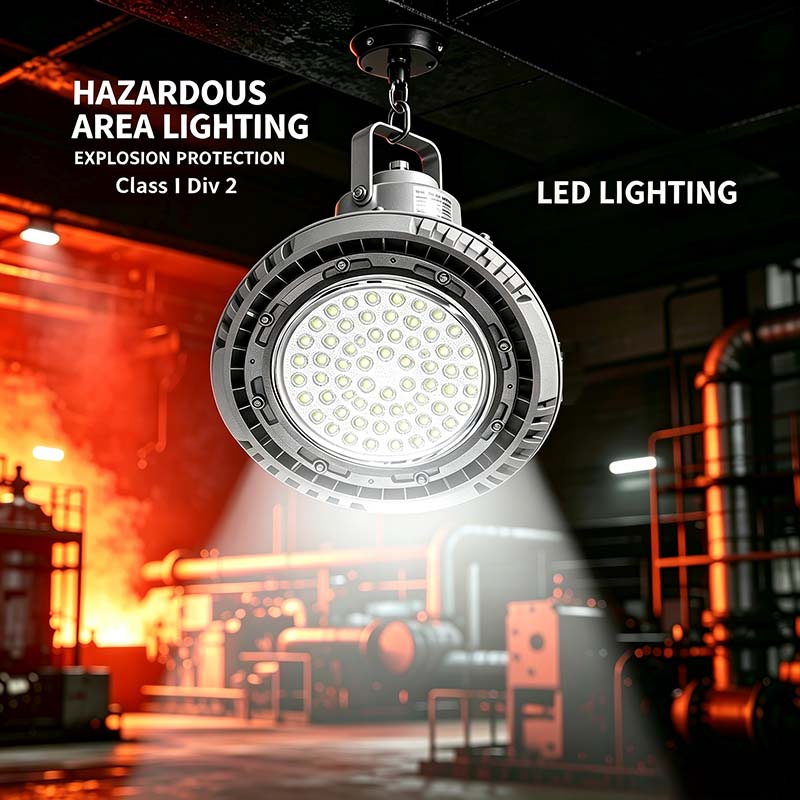
A hazardous location is defined by safety standards—such as the National Electrical Code (NEC) in North America and the IEC/ATEX directives internationally—as an environment where flammable gases, vapors, liquids, combustible dusts, or ignitable fibers are present in quantities sufficient to produce explosive or ignitable mixtures. Lighting in these locations must prevent internal electrical arcs, sparks, or thermal surface energy from triggering an explosion.
This B2B technical guide breaks down classification systems, temperature codes, ingress standards, and specialized luminaire designs.
Hazardous environments are classified based on the nature of the hazardous material and the probability of its presence in the atmosphere.
                                                                    Global Hazardous Location Framework
  ┌─────────────────────────────────────┬─────────────────────────────────────┐
  │       North American System                                                  │         International System                                                     │
  │          (NEC Class/Division)                                                   │            (IECEx / ATEX)                                                          │
  ├─────────────────────────────────────┼─────────────────────────────────────┤
  │ Class I: Gases, Vapors, & Liquids                                        │ Zone 0 / Zone 1 / Zone 2 (Gas)                                             │
  │ Class II: Combustible Dusts                                                 │ Zone 20 / Zone 21 / Zone 22 (Dust)                                      │
  │ Class III: Ignitable Fibers/Flyings                                          │ Group I (Mining) / Group II (Gas)                                         │
  └─────────────────────────────────────┴─────────────────────────────────────┘
Class I: Locations containing flammable gases, flammable liquid-produced vapors, or combustible liquid-produced vapors.
Class II: Locations made hazardous by the presence of combustible dust (e.g., grain, flour, coal, or metal dust).
Class III: Locations containing easily ignitable fibers or flyings (e.g., textile mills, wood processing).
Division 1: Flammable hazards exist continuously, intermittently, or periodically under normal operating conditions.
Division 2: Flammable hazards are present only under abnormal conditions (e.g., container failure, equipment breakdown).
Zone 0 / Zone 20: An atmosphere where explosive gas (Zone 0) or combustible dust (Zone 20) is present continuously or for long periods.
Zone 1 / Zone 21: An atmosphere where explosive gas (Zone 1) or combustible dust (Zone 21) is likely to occur in normal operation.
Zone 2 / Zone 22: An atmosphere where explosive gas (Zone 2) or combustible dust (Zone 22) is not likely to occur in normal operation and, if it occurs, persists for a short period only.
| Hazard Material Type | Frequency of Exposure | NEC 500 Class/Division | IECEx / ATEX Zone Rating | Luminaire Protection Requirement |
| Flammable Gas / Vapor | Continuous / Long Period | Class I, Division 1 | Zone 0 / Zone 1 | Explosion-Proof / Flameproof Enclosure ($\text{Ex d}$) |
| Flammable Gas / Vapor | Abnormal / Short Period | Class I, Division 2 | Zone 2 | Non-Sparking / Increased Safety ($\text{Ex ec}$) |
| Combustible Dust | Continuous / Long Period | Class II, Division 1 | Zone 20 / Zone 21 | Dust-Ignition Proof Enclosure ($\text{Ex tb}$) |
| Combustible Dust | Abnormal / Short Period | Class II, Division 2 | Zone 22 | Dust Protected Enclosure ($\text{Ex tc}$) |
| Ignitable Fibers | Intermittent / Storage | Class III, Division 1 & 2 | Zone 21 / Zone 22 | Sealed Enclosure with Surface Temp Limiting |
Engineering lighting for hazardous locations lighting requires strict adherence to physical thermal management, electrical protection, and material resilience parameters:
Every hazardous location fixture receives a Temperature Code (T1 to T6) defining its maximum operating surface temperature under full load. The fixture's T-Code temperature must remain lower than the auto-ignition temperature of the specific gas or dust present:
T1: ≤ 450°C
T2: ≤ 300°C
T3: ≤ 200°C
T4: ≤ 135°C (Standard benchmark for chemical plants)
T5: ≤ 100°C
T6: ≤ 85°C (Highest thermal rating; required for volatile substances like Hydrogen Cell areas)
Hazardous environments frequently feature high ambient moisture, airborne oils, chemical fumes, and mechanical risks:
Ingress Protection (IP66/IP67/IP68): Prevents water ingress under high-pressure spray and immersion, preventing moisture from corroding internal driver circuitry.
Impact Protection (IK10): High-grade tempered glass lenses and cast housings absorb mechanical impacts without cracking.
Standard commercial aluminum degrades rapidly when exposed to corrosive industrial atmospheres. Hazardous location luminaires utilize copper-free AL 6063 aluminum alloys or 316 stainless steel with powder coating. Heat dissipation fins prevent thermal energy from accumulating near driver modules.
When specifying luminaires for hazardous facilities, select certified products engineered for high efficiency:
Petrochemical Refineries & Offshore Platforms: Facilities require Zone 1 / Zone 21 certified fixtures equipped with robust surge protection (up to 10kV) and copper-free housings to withstand saltwater spray and chemical vapors.
Grain Processing & Flour Mills: High concentrations of organic dust require Class II, Division 1 (Zone 21) dust-ignition-proof fixtures with smooth housing designs that prevent dust buildup on thermal heat sinks.
Automotive Spray Paint Booths: Paint booth lighting demands Class I, Division 1 / Zone 1 compliance, combined with high Color Rendering Index (CRI > 80/90) for color matching.
Discover specialized industrial fixtures designed for tough environments by exploring our full range of
Before requesting a DIALux photometric plan or B2B quote for hazardous location lighting, compile the following facility details:
Hazard Classification: Specific Class/Division or Zone rating (e.g., Zone 1 vs. Zone 2).
Atmospheric Group: Gas group (IIA, IIB, IIC) or Dust group (IIIA, IIIB, IIIC).
Required T-Code: Ambient temperature rating and auto-ignition parameters ($T_1-T_6$).
Environmental Conditions: Chemical exposure, saltwater mist, washdown pressures, and ambient operating temperature ranges
Mounting Configuration: Ceiling mount, wall bracket, stanchion, or pendant chain installation.
A: An "explosion-proof" light fixture is not designed to withstand an external nuclear blast. Instead, its enclosure is engineered to contain an internal explosion ignited by internal electrical sparks. It cools and vent escaping flame paths so they cannot ignite the surrounding hazardous atmosphere outside the luminaire.
A: ATEX is a mandatory legal directive required for all equipment sold or installed within the European Union hazardous locations. IECEx is an international certification scheme recognized globally across member nations. Both certifications evaluate similar engineering standards (such as EN/IEC 60079 series).
A: No. A standard IP66 tri-proof linear fixture provides protection against water and dust, but it lacks flameproof path seals, certified spark-free circuitry, and T-code thermal compliance required for Zone 1 or Zone 21 explosive atmospheres. Hazardous locations require dedicated ATEX/IECEx certified explosion-proof luminaires.
Ensure site safety and regulatory compliance across your industrial facilities. Partner with Unicornlite for photometric layouts, certified product specifications, and custom


